Research
Many social, organizational, and economic phenomena benefit from a systems perspective. In my research, I develop statistical methods for social network data and other nontraditional data in the social sciences.
Network dynamics
To understand the emergence of social networks and their consequences on individual behavior, a dynamic perspective on networks is crucial. Studying the evolution of networks over time allows us to zoom in on the social mechanisms driving network change. However, the mutual dependencies between actors and between ties in social networks imply that standard statistical methods cannot be straightforwardly applied to social network data. I work on statistical models for network dynamics in the stochastic actor-oriented modeling framework. I have developed models for the co-evolution of networks and individual attributes, employing continuous-time Markov chains and stochastic differential equations. I have implemented my methods in the R package RSiena. In conference workshops, I teach researchers how to apply the methods to their own data and interpret their results. A didactic vignette is available under Code. A significant next step in this research line revolves around the causal interpretation of stochastic actor-oriented model parameters.
Research supported by: NWO (Dutch NSF) Research Talent Grant.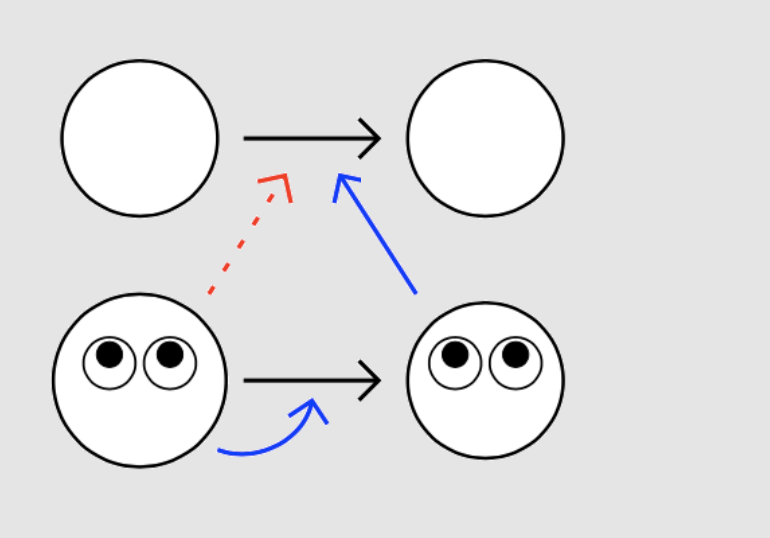
Three-way network analysis
Conventional models for social network data focus on two-party (sender-receiver) relationships. Complementing these with an extra dimension is critical to understanding social phenomena ranging from network perception biases (perceiver-sender-receiver relations) to gossip (sender-receiver-target relations). I develop methods to study longitudinal three-way network data. Planned applications will study whether network perceptions in organizations shape career advancement, and how this differs between men and women, as well as whether people with a dual identity, who may act as bridges between groups, are seen that way by others, and how these perceptions relate to intergroup contact and prejudice.
Research supported by: NSF Methodology, Measurement, and Statistics Grant.

Relational event models in criminology
In criminology, scholars often need to rely on police record data to learn about social interactions among offenders. Often, such data are aggregated over time, and analyzed by cross-sectional network methods. Yet, much can be learned from how criminal events unravel over time. Therefore, I develop and apply relational event models to study the dynamics of crime. In standard relational event models, the unit of observation is the relational event, indicating who sent a tie to whom at what time. I develop extensions of this framework, for application in criminology and beyond.
Research supported by: Carnegie Mellon University Berkman Faculty Development Grant.
Networks and (statistics) education
Social networks play a major role in students’ experience in higher education. I have worked on several projects assessing the effect of networks on students’ behavior and evaluated the effect of strategies to improve students’ social experience. I’m particularly interested in strategies to reduce segregation in higher education and to prevent students’ social isolation.
I also study how students learn statistics and data science. Taking a network perspective, I examine how students’ social relations and sense of belonging relate to their academic performance. With colleagues in the department, I analyze the structure of student writing using sentence type transition matrices. Starting in 2027, I will study how students learn statistical concepts using AI.
Research supported by: Carnegie Mellon University Provost’s Inclusive Teaching Fellowship and Carnegie Mellon University Generative AI Teaching as Research (GAITAR) Fellowship.